
In the cost breakdown of many industrial projects, equipment prices are discussed repeatedly:
How large should the unit be? Which brand should we choose? What is the upfront investment?
Yet anyone who has experienced production fluctuations, unplanned shutdowns, or urgent capacity expansion knows this well—
the most expensive factor in industrial operations is rarely the equipment itself, but uncertainty.
Ⅰ. Equipment Is Predictable. The Site Never Is.
The specifications of an air compressor are clear and measurable:
power, flow rate, pressure, dew point—everything looks precise on paper.
The jobsite, however, is never static:
- Orders fluctuate, and output rises and falls
- Multiple projects run in parallel, with urgent tasks added unexpectedly
- Maintenance windows are compressed
- Weather, environment, and system load constantly change
Equipment can be calculated.
Operations, more often than not, cannot.
What truly separates costs over time is not the equipment selected at the beginning, but how the system responds to uncertainty.
Ⅱ. Uncertainty Is Often Ignored—Until It Becomes a Problem
Many operational risks do not surface immediately:
- Oil contamination does not instantly cause product rejection
- Dew point fluctuations may remain “within acceptable limits”
- Pressure instability is temporarily managed by experience
As a result, risks are postponed and gradually normalized.
But industrial systems do not forget risk—they accumulate it.
When operating conditions shift, workloads overlap, or time extends,
previously ignored uncertainty often reappears as downtime, rework, or even safety incidents.
Ⅲ. The Management Focus Is Shifting—from Equipment to Certainty
Across a growing number of industrial projects, a noticeable change is taking place.
The key question is no longer simply, “How much does the equipment cost?”
but rather, “How controllable is the system?”
Attention is increasingly placed on:
- Whether the air supply is stable and predictable
- Whether redundancy exists when abnormal conditions arise
- Whether capacity can expand or contract quickly
- Whether responsibility and response mechanisms are clearly defined
From this perspective, companies are no longer evaluating equipment alone—
they are evaluating the certainty built around it.
Ⅳ. The True Value of Rental Is Transferring Uncertainty
Viewed this way, air compressor rental delivers far more than cost savings:
- Equipment failures are no longer borne solely by the user
- Temporary capacity does not require long-term investment
- Projects end without leaving asset burdens
- Technical risk is managed by specialized professionals
In high-purity, high-risk environments—especially oil-free air applications—
rental becomes a strategic choice, allowing companies to outsource uncertainty
and focus on production and delivery.
Ⅴ. FOOENS Provides More Than Air
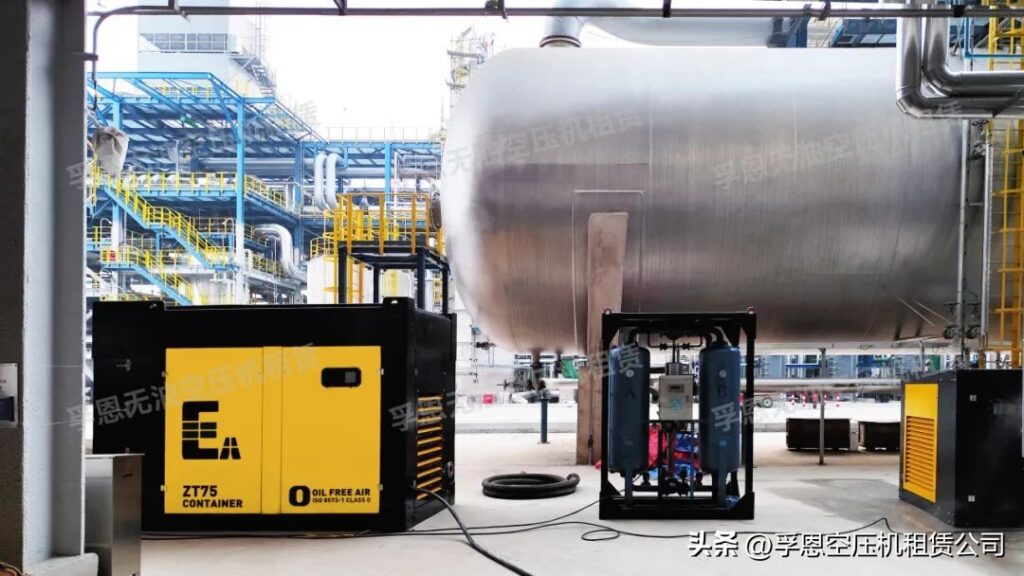
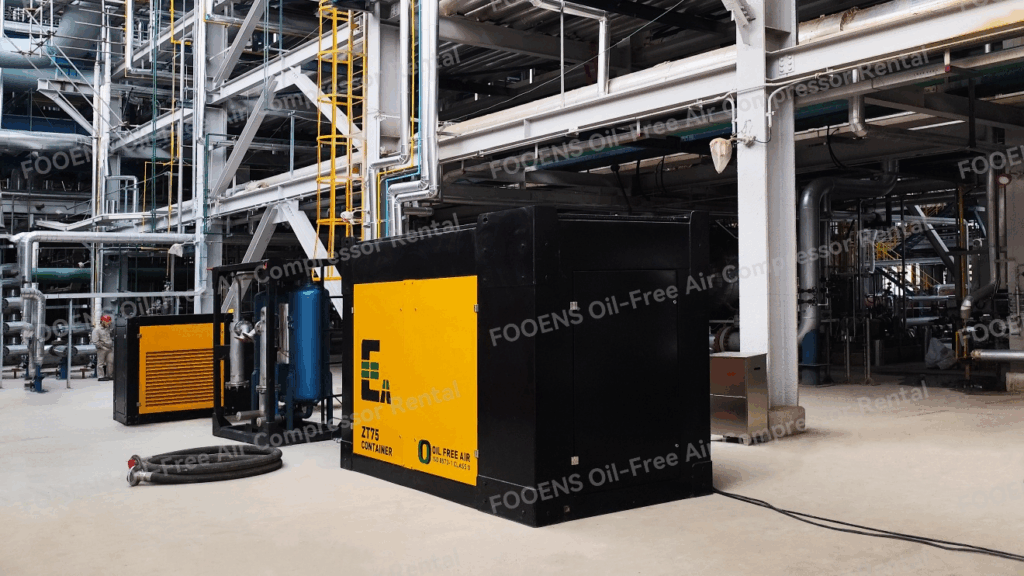
In real-world projects, FOOENS serves not merely as an equipment supplier,
but as a provider of operational certainty:
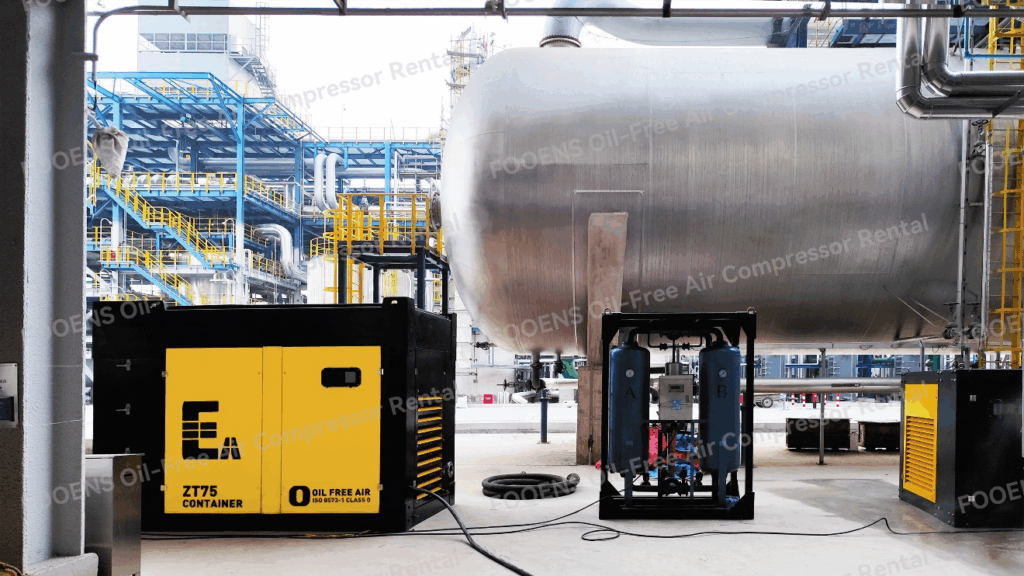
- Integrated oil-free compressors and drying systems
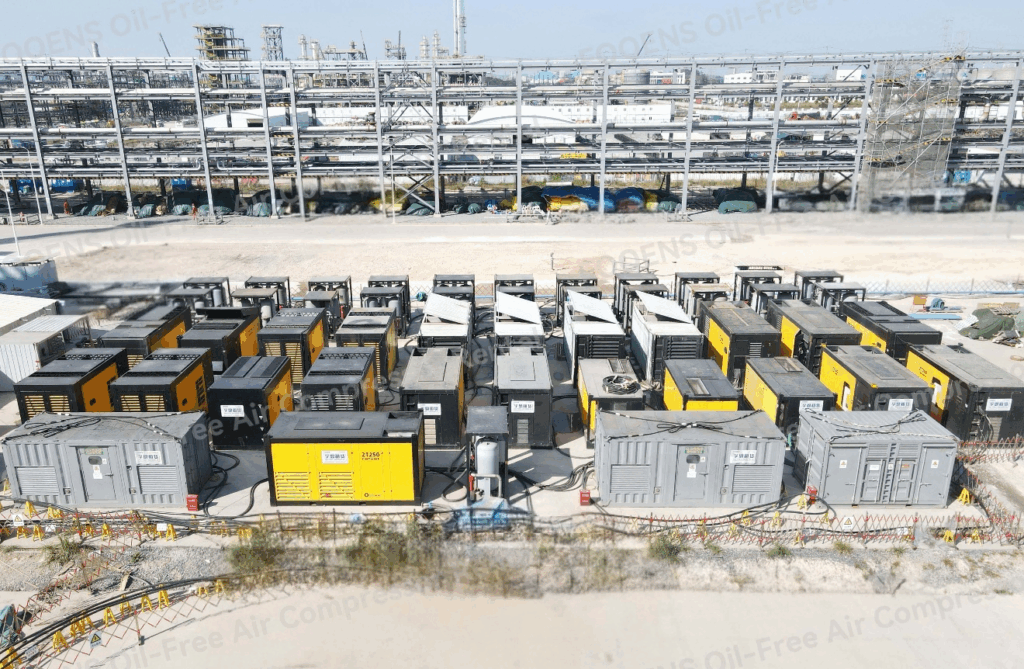
- Multi-unit parallel configurations for peak and emergency loads
- On-site engineers monitoring performance
- Rapid replacement and adjustment when conditions change
For customers, the result is not simply “one more machine,”
but smoother operations and clearer risk boundaries.
Conclusion: Industrial Competition Is Shifting from Capability to Stability
As capacity and technology become increasingly standardized,
true differentiation lies elsewhere:
- Who can remain stable amid uncertainty
- Who can deliver consistently through change
Equipment is only a tool.
Certainty is the scarcest—and most valuable—resource on an industrial site.
And this is precisely the direction in which
FOOENS Oil-Free Air Compressor Rental continues to invest.
 English